Scottish clothing
Women's kilts: how they differ from men's kilts and tartan skirts
What a women's kilt or kilted skirt is, how it differs from a men's kilt and a plain tartan skirt in construction and fit, and what custom says about women wearing kilts.
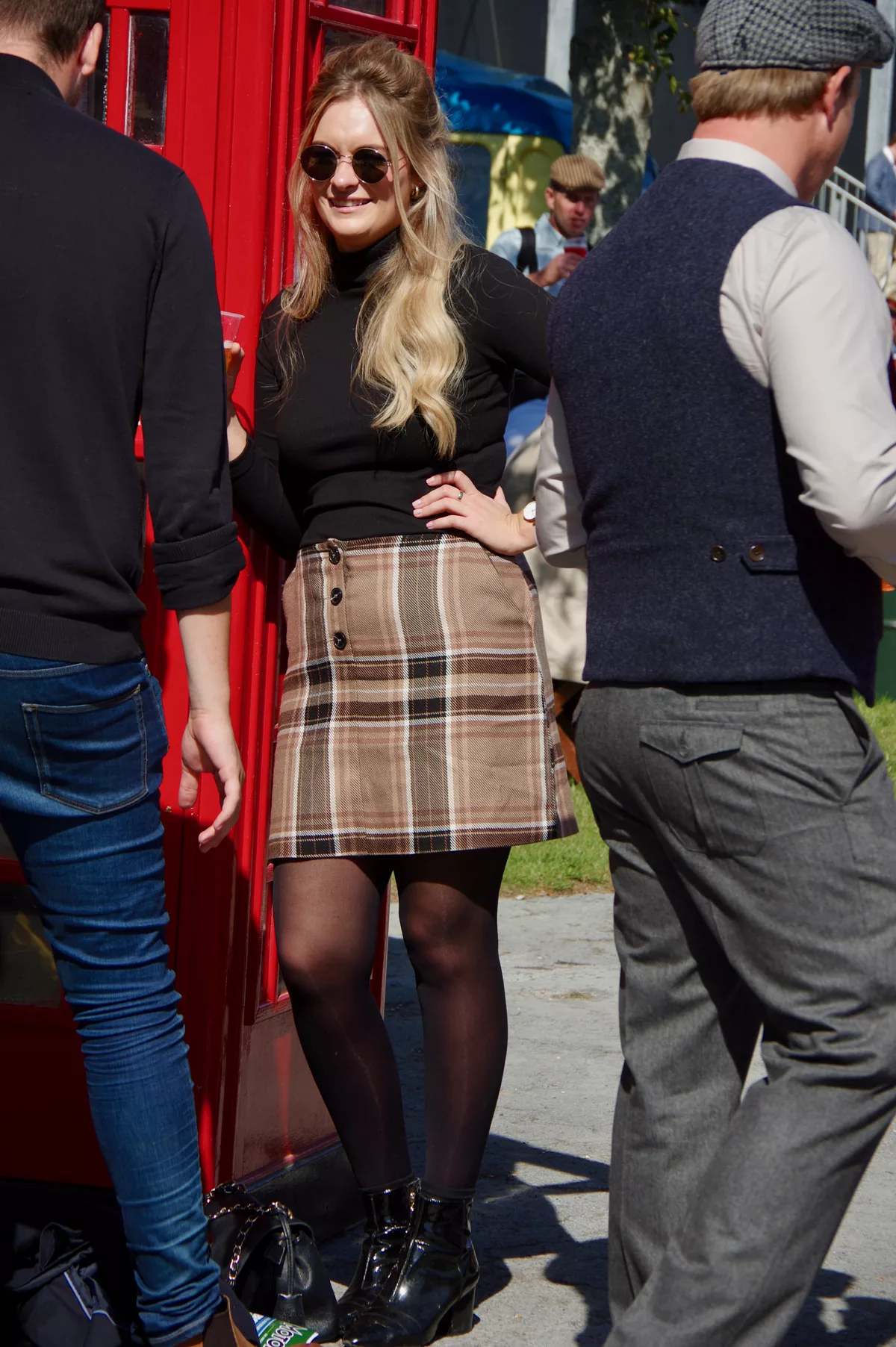

Yes, a women’s kilt is usually a different garment from a men’s kilt. The version made for women, often sold as a kilted skirt, is lighter, closes on the opposite side, and comes in a choice of lengths. A tartan skirt is a third thing: any skirt made from tartan cloth, with no obligation to follow kilt construction.
Where sellers use “women’s kilt”, “kilted skirt” and “kilt skirt” interchangeably, check the construction. For the men’s garment these are compared with, see what a kilt is. The answers below come from a clan society’s dress guide, which is one source and a regional preference rather than a rule.
Three garments compared
| Garment | Construction | Closure | Cloth weight | Length |
|---|---|---|---|---|
| Men's kilt | Wrapped and pleated, aprons at the front, worn at the natural waist (kilt reference article) | Closes to the right | Heavier; 13 or 16 oz is common (kilt reference article) | About knee length (kilt reference article) |
| Women's kilted skirt | Pleated and kilt-style; wrapped front apron | Closes to the left, with the pin on the left side | Lighter than a man's kilt; typically medium, with an 11 oz light weight also offered | Knee, tea length (halfway between knee and ankle) or hostess (long, almost to the floor) |
| Tartan skirt | Any cut; pleating optional | Not established; no single convention | Not established | Any |
The Buchanan guide adds that mass-produced “active kilts” for women usually have the apron closing to the right, as on a man’s kilt. So the left-closing rule describes the traditional women’s kilted skirt, not every garment sold as a women’s kilt.
Fit and length
On length the Buchanan guide separates occasions: knee and tea length can be worn at any time, while the hostess skirt, almost reaching the floor, is usually reserved for formal functions. The same page notes that “tea length” is not used in the same way in every country. That matters when ordering from a maker you have not used before, because the same word may describe two different hems.
The guide’s measuring instructions are short and specific. It asks for three numbers: the waist, taken at the smallest point; the hips, taken at the widest point; and the length, from the navel to the hemline you want. It advises measuring while wearing a dress shirt or blouse, and keeping the tape snug, neither tight nor sagging.
Compare that with the men’s rule. The kilt article on Wikipedia, a level D pointer, says a properly fitted men’s kilt covers the body from the waist to the centre of the knees, reaching no lower than halfway across the kneecap and no higher than about an inch above it. A women’s kilted skirt has no matching single standard. A knee-length skirt is one choice among three, so the length is a decision made per outfit, not a fit rule. The general how to measure for a kilt guide and the kilt size calculator are written for men’s kilts, which are measured differently, so treat their output as a starting point only.
Cloth weight shows the same gap. The Buchanan page puts women’s kilted skirts in medium weight or light weight (11 oz) tartan, and notes that the lighter cloth drapes well for outfits such as an arisaid. The Wikipedia article gives 13 oz and 16 oz as the most common men’s kilt weights, with lighter cloth around 10 to 11 oz and heavy regimental worsted around 18 to 22 oz. The lighter 11 oz cloth falls at the bottom of the men’s range, so the ranges overlap. The overlap shows that weight alone does not make a garment a women’s kilt.
What women wore before the kilted skirt
The arisaid (Gaelic earasaid) is the garment most often named as the women’s counterpart to the great kilt. According to Wikipedia’s summary, which should be read as a pointer to the primary accounts, it was a large rectangle of wool or silk, longer than the wearer’s height. It could be belted into a pleated dress or worn unbelted as a wrap, and could be drawn over the head. The same article cites Martin Martin describing a plaid reaching from the neck to the heels, fastened with a silver or brass buckle, Edward Burt in 1754 describing striped or chequered plaids in silk or fine worsted, and Thomas Pennant in 1769 describing women drawing it forward over the face during church services. It also says the 1845 McIan illustrations reconstructed the garment from written accounts roughly a century and a half old.
Two cautions follow. First, the arisaid is a wrapped garment, not a skirt with sewn pleats, so a modern kilted skirt is a different object even when a maker calls it an arisaid-style piece. Second, the descriptions come from a handful of visitors and one nineteenth-century illustrator. They do not show a continuous, documented line from the arisaid to today’s kilted skirt, and we found no source that establishes one.
Is there a rule about women wearing kilts?
For the wider question of who sets rules for Highland dress at all, see the Highland dress overview.
No rule has been established. The sources read describe custom and event rules, not law.
The nearest thing to an authority statement comes second-hand. The American Clan Gregor Society’s article “Women Wear the Sash” quotes the current Lord Lyon’s web site as saying there are “no strict rules” on wearing tartan. We could not open the Lyon Court page itself, so that wording rests on the society’s quotation. The same article concludes that women should wear their sashes however they like, as is common at Highland Games.
Practice among dancers shows how much the answer depends on the setting:
- The Buchanan guide says female members of pipe bands and female Highland dancers traditionally wear men’s attire. That is a statement of practice, not a prohibition.
- The Aboyne Highland Games committee barred women from wearing kilts, sporrans and medals from around 1949, introduced an alternative dress in the early 1950s, and formalised the rules by September 1954, according to Wikipedia’s account of the Aboyne dress. That governs one competition and one era.
- Elsewhere female dancers do wear kilts. The Scottish Official Board of Highland Dancing dress rules, as mirrored on scottishdance.net, require a kilt for the female Type 1 and Type 2 outfits, in any clan, family or district tartan, reaching the top of the knee. The Type 1 outfit adds a velvet jacket or waistcoat, a white blouse and clan tartan or diced hose; Type 2 uses white three-quarter-length hose and a plain blouse with a tie. A North American cultural society page says the same, that female competitors are expected to wear a kilt.
- For the national dances the rules list a gathered tartan skirt reaching the top of the knee, with a plaid fastened at the right shoulder with a cairngorm brooch, or alternatively a white dress with a tartan sash worn from right to left. The rules say the skirt should be gathered, not circular.
So the accurate summary is that the Aboyne ban and the Board’s kilt rule coexist. The Buchanan page’s “men’s attire” wording is true in the sense that the kilt, jacket and hose descend from men’s dress, but the Board’s female outfit is its own specification with its own jacket, blouse and hose, not men’s clothing worn unchanged. The Board’s text we read is a mirror on a third-party site, so confirm the current wording with the Board before ordering for a competition.
A contemporary reference notes that kilts are widely worn by girls and women at Canadian schools with uniform policies and that field hockey and lacrosse players wear a simple contemporary kilt. Those are uniform conventions and say nothing about Highland dress.
The sash question
Women’s kilted outfits often include a tartan sash, and the shoulder it crosses is the point where guides disagree. The American Clan Gregor Society article describes mid-twentieth-century guidance: clanswomen wear the sash on the right shoulder, while chieftainesses and chiefs’ wives wear it on the left. The article argues those rules date only from the middle of the twentieth century. It cites Loudon M. Douglas’s 1914 manual, The Kilt: A Manual of Scottish National Dress, which suggested that ladies wear the sash over the left shoulder with evening dress, and otherwise left the use of tartan to personal taste.
The author’s own view, which is an opinion and not a finding, is that right-handed women find the left shoulder more comfortable and that Highland Games attendees now wear sashes in all manner of ways. The dance rules read for this page point the other way for dancers, with the sash worn from right to left and the plaid pinned at the right shoulder. If you are dressing for a clan gathering, ask the society, because some follow the right-shoulder convention and the older printed advice differs.
Where the kilted skirt sits in time
The kilt article on Wikipedia says tartan setts are always arranged horizontally and vertically, never diagonally, “except when adapted for women’s skirts”. That is a one-line aside, with no explanation of which skirts it means, but it is a reminder that a women’s skirt is allowed liberties with the cloth that a men’s kilt is not.
The Victoria and Albert Museum holds a dated example of the kilt-style skirt as fashion. Its record T.68-1974 describes a mini-length, kilt-style skirt in white cotton piqué, retailed by Henri Bendel of New York in 1966, with two buckled straps at the waist, a wrap-over front and two pleats in the front panel. It was given by the model Jean Shrimpton (V&A: skirt, 1966). It is not tartan, and the record does not say it was meant as a copy of Highland dress. It does show that wrap-and-buckle construction on a short women’s skirt was on sale by the mid 1960s. For the cuts and hem names that grew out of that decade, see the tartan skirts guide.
Questions people ask
Is a women’s kilt the same as a kilt for a man? Not usually. The Clan Buchanan Society describes the women’s kilted skirt as closing to the left, in a lighter cloth, with knee, tea or hostess lengths, while its men’s kilt closes to the right. It also says mass-produced active kilts for women often close to the right.
What is the difference between a kilt skirt and a tartan skirt? “Kilt skirt” and “kilted skirt” describe a skirt built on kilt lines: pleated and wrapped, with a flat front apron. A tartan skirt only has to be made of tartan. The sources read give no legal or registry definition of either term.
Which side does a women’s kilt fasten? The Buchanan guide gives the left, with a kilt pin on the left side (see kilt pins). That is one society’s description of the traditional pattern, and not every maker follows it.
Can women wear a kilt? No rule against it has been established in the sources read. The Lord Lyon web site is quoted second-hand as saying there are “no strict rules” on wearing tartan, and event rules such as the Aboyne dress or Highland dance dress codes apply only to those events.
How much does a women’s kilted skirt weigh? The Buchanan page says women’s kilted skirts are generally in medium-weight tartan, with a light weight (11 oz) also used. For how cloth weight and fibre change the way tartan wears, see wool vs acrylic tartan.
Choosing between the options
If the aim is a kilt-style garment for formal wear, a kilted skirt in the Buchanan description is the closest to the traditional pattern for women. If the aim is only tartan, a tartan skirt gives more freedom of cut and cloth. For kilt types, with pleat and fabric differences, see kilt types. Tartan choice raises the same questions for everyone; see who can wear which tartan.
Sources
The Clan Buchanan Society page on choosing a kilt or kilted skirt supplies the closure, weight, length and women-in-men’s-attire statements. The Buchanan dance page and the Scottish Cultural Organization of the Triangle page support the dancers’ attire. The Aboyne dress article supplies the games committee history. The Wikipedia kilt and arisaid articles supply the men’s kilt baseline, the school and sports uses, and a summary of the arisaid accounts. The American Clan Gregor Society article supplies the sash discussion and the Lord Lyon and Douglas quotations. The Highland dance rules come from the Scottish Official Board of Highland Dancing text as mirrored on scottishdance.net. All are secondary, clan-society or association material rather than registry or museum sources.